The short answer
If your furnace blows cool air, short cycles, makes new noises, or smells like it's burning, it likely needs repair. Most problems, like a failed igniter, dirty flame sensor, or worn capacitor, are fixable. Replacement makes more sense for a cracked heat exchanger or an older furnace that keeps breaking down.
San Jose winters are mild, but nights in the Santa Clara Valley still get cold and damp enough that a furnace that won't start becomes a real problem fast. Many homes here run the heat only a few months a year, so furnaces often sit idle through the long, dry summer and then act up during the first cold week of fall. NextLevel AC Repair Service repairs gas furnaces for homeowners in San Jose and nearby cities. This page covers the warning signs to watch for, what our technicians check, how to think about repair versus replacement, what affects the cost, and what to expect during a visit.
Signs Your Furnace Needs Repair
Some furnace problems are obvious, like no heat at all. Others build slowly and are easy to ignore until the system quits. Schedule service if you notice any of these:
If you smell gas or a carbon monoxide alarm sounds, don't troubleshoot. Get everyone outside, then call your gas utility or emergency services from outside the home. Once the home is safe, we can diagnose the furnace.
- The furnace runs but blows cool or lukewarm air.
- It won't start, or it starts and shuts off after a few minutes (short cycling).
- Some rooms stay cold while others warm up.
- New noises, such as banging at startup, squealing, scraping, or rattling.
- A burning or dusty smell that doesn't fade after the first few minutes of the season.
- The burner flame looks yellow or flickers instead of burning steady and blue.
- The igniter clicks repeatedly, or an error code is blinking on the control board.
- Your gas bill rises even though you haven't changed how you use the heat.
- Your carbon monoxide alarm goes off, or people in the home get headaches or nausea that ease when they leave.
What We Check During a Furnace Repair Visit
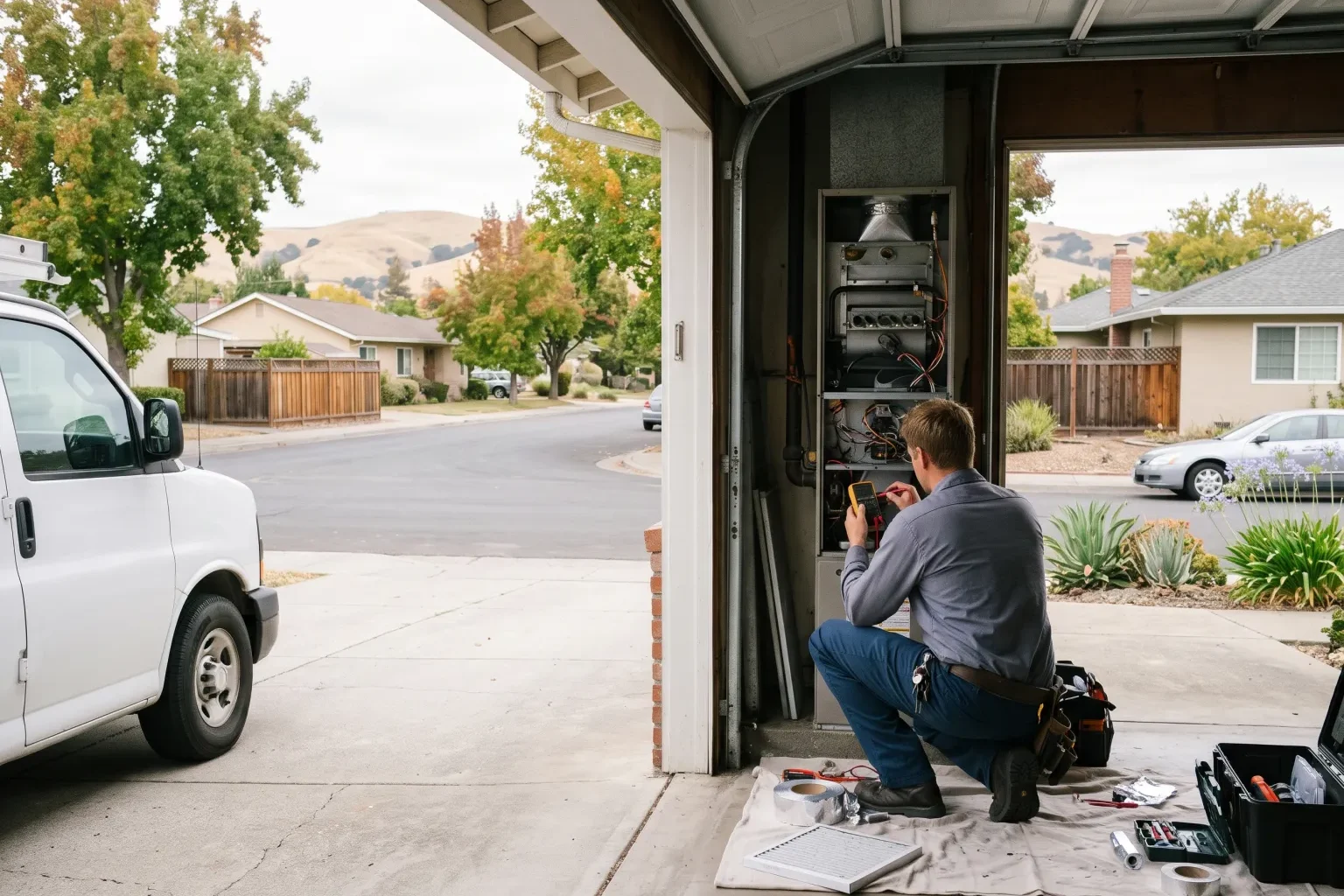
A good repair starts with finding the actual cause, not just treating the symptom. Our technicians work through the system in order, from the thermostat to the vent pipe. That way, fixing one problem doesn't leave a second one hidden somewhere else.
After testing, we explain what we found in plain language and show you the failed part when possible. We also tell you which issues need attention now and which can wait.
- Thermostat settings, wiring, and batteries
- Air filter condition and airflow through the return and supply ducts
- Igniter or pilot assembly and the flame sensor
- Burners, gas valve, and gas pressure
- Heat exchanger, inspected for cracks, rust, or signs of overheating
- Blower motor, capacitor, and blower wheel
- Inducer motor, pressure switch, and limit switches
- Control board and any stored error codes
- Flue and venting, plus condensate drains on high-efficiency models
- Carbon monoxide levels near the furnace and at the supply registers
Repair or Replace?
Most furnace problems can be repaired. A failed igniter, dirty flame sensor, worn capacitor, or clogged filter is usually a straightforward fix. Replacing a working furnace over a small part rarely makes sense. Replacement is worth discussing in four situations: the heat exchanger is cracked, the furnace is old and needs repairs often, parts are hard to find, or the system can't keep the house comfortable even when everything is working.
Local rules are part of that conversation. Under Bay Area Air District Rule 9-4, natural gas furnaces manufactured starting in 2029 must meet a zero-NOx emission standard. In practice, that points homeowners toward heat pumps when they replace a furnace after that date. The rule does not require you to replace a furnace that still works. It applies only when equipment fails or is replaced, so repairing your current furnace remains an option.
If you're leaning toward a heat pump, it helps to understand incentives. The federal Energy Efficient Home Improvement Credit covered heat pumps placed in service before December 31, 2025, and it isn't available for new installations. Bay Area homeowners can check BayREN and their local clean energy provider for current heat pump and electrification incentives. Those programs change by funding cycle, so we confirm what's currently offered before including it in any quote. Winters in the Santa Clara Valley are mild and damp, and inland areas get hot in summer. A heat pump can provide both heating and cooling, which suits that climate.
What Affects the Cost of Furnace Repair
We can't give an accurate cost until we've diagnosed the furnace. These are the factors that shape the final cost:
Before any work begins, we explain your repair options and what each one costs, so you can decide how to proceed.
- The part that failed. Cleaning a flame sensor is a very different job from replacing a blower motor or control board.
- Part availability, especially for older or less common furnace brands.
- Furnace type and location. Units in tight attics, closets, or crawlspaces take longer to reach and work on.
- Whether we find more than one problem, such as a bad igniter plus a failing inducer motor.
- Timing, if you need service outside normal working hours.
- Related work needed for safe operation, such as venting corrections or duct repairs.
How a Furnace Repair Visit Works
Here is what to expect from start to finish:
To prepare, clear a path to the furnace and secure your pets. If you have the furnace's model number or past service records, keep them handy for the technician.
- Scheduling: Tell us the symptoms, where the furnace is located, and any error codes or sounds you've noticed. This helps the technician bring likely parts.
- Arrival and diagnosis: The technician asks a few questions, then inspects and tests the system.
- Findings and options: We explain the problem and your repair choices. If replacement is worth considering, we explain why.
- Repair: With your approval, we make the repair and replace parts as needed.
- Testing: We run the furnace through full heating cycles, check the safety controls, and confirm the house is heating properly.
- Wrap-up: We review what we did and anything to watch for, such as regular filter changes.
Furnace Repair by city
- Furnace Repair in Morgan Hill
- Furnace Repair in Los Gatos
- Furnace Repair in Campbell
- Furnace Repair in Monte Sereno
- Furnace Repair in Saratoga
- Furnace Repair in Santa Clara
- Furnace Repair in Milpitas
- Furnace Repair in Cupertino
- Furnace Repair in Sunnyvale
- Furnace Repair in Scotts Valley
- Furnace Repair in Gilroy
- Furnace Repair in East Foothills